10 November 2017

/

View of Pikey Peak with clouds sticking to one side of the ridgeline.

Stage 2 started in in the town of Bhandar and finished just below Pikey Peak summit after 23.9 km or 14 miles in Jase Bhanjyang. We had to ascend 3,486m or 11,500ft and descend 1,796m or 6,000ft including summiting and descending Pikey Peak. 

View from Pikey Peak summit.

Just based on those elevation numbers, all runners expected stage 2 to be one of the tougher stages, if not the toughest stage. We still had a stage with more distance and another stage with serious descent, but this stage included not only nearly 12,000ft of vertical gain, but also the highest point on the entire Everest Trail Race course wih Pinkey Peak at 12,400ft.

View from Pikey Peak summit.

I had completed my first stage in 14th place overall after getting lost for about 20 minutes, but without any injuries or even niggles. My feet had held up so far, i.e. no blisters or hotspots, and I was able to get some rest. Immediately upon finishing stage 1, I had put on my CEP recovery compression tights to start my recovery. These tights were one of my optional items that I felt would help me recover more quickly during a multistage event like this one, especially concerning the amount of ascending and descending we had to endure. These tights were definitely worth their 160g in weight. 

View from course looking back at Pikey Peak.

While on the subject of rest and recovery, running was only one part of our daily routine during the Everest Trail Race. Over the course of 6 days, I would only spend 3.5 to 6 hours a day running. After each stage, I would immediately get out of my running clothes and get into my recovery/camp clothes. I would usually spread out the running clothes across our tent roof in an effort to dry them followed by a quick bucket shower in the wash tent. Sometimes this water was actually warm, but most of the time it was cold my the time I got there. 

Pikey Peak.

Sherpa and race staff would serve up hot tea or coffee along with some cookies for all finishers in the mess tent. There would also be soup, pasta, rice and potatoes to replenish and refuel immediately after completing a stage. In short, we were treated exceptionally well, which is really not what I would have expected beforehand. Thanks again to the over 160 staff that consisted of local Sherpa, porters, cooks and guides and staff from Spain and Italy. My experience in Nepal would have been greatly diminished without the tireless efforts and support of all of them. Everyone was always there to lend a helping hand and tend to our every need.


Dinner would generally be served at 6:30PM. By that time, runners would usually have completed the race stage. Every meal served was largely a reflection of local foods, i.e. vegetarian diet with a focus on carbs. This made it fairly easy for me to stay on my vegan diet. There were only a couple of instances were I could not be 100% certain whether something was actually dairy free, but that is something someone must be willing to accept when participating in any endurance event.

View from Pikey Peak approach.

Dinner was the time we'd usually discuss the stage we just completed as well as the stage that lay ahead. By 8PM, most of us would be in our tents ready to get some rest before the next stage. My sleep pattern was pretty inconsistent. I would wake up just about every hour most nights, but I always felt well rested every morning. I had heeded advice I had found online and brought ear plugs to minimize ambient noise from both wildlife (mostly howling wild dogs) and fellow racers (snoring and chatting:-)

Climb towards Pikey Peak through forrest.

Starting with stage 2, runners would start every stage but the last one in 2 waves, a 7AM start for the bottom 15 runners from the previous stage and an 8AM start for the other runners. Wakeup calls by the Sherpa would take place at 5AM and 5:30AM respectively accompanied with hot cups of tea. It's probably the thing I will miss the most from this experience:-)


By 6AM, most of us would have assembled in the mess tent for breakfast. There would usually be lots of options including toast, jam, cheese, eggs, serial, muesli, potatoes, etc. along with hot coffee and tea. I all but eliminated coffee from my diet during the race as I generally like some non-dairy creamer in my coffee, which was not available. Tea was a much easier option for that reason. Even though I am a heavy coffee drinker (5-6 cups a day), I thankfully had no signs of withdrawal:-) I did drink a total of one or two cups during the 8 days in the Himalayas. Tea just tasted better here.

Farmer's home along the course.

At 7AM runners would usually line up to receive their first rations of water and fuel. This would be a liter of water along with 2-3 gels and 1-2 energy bars. My reliance of provided fuel choices was a bit of a risk factor and it did end up affecting my ability to get enough calories. I just could not stomach the bars and had to rely solely on the gels provided. Considering the amount of effort required every day, this was not enough fuel, but I managed for the most part.

Example of the technical terrain along most of the race course.

Stage 2 was kicked off by the first group of runners at 7AM. It was still pretty cold at that time, but just a few minutes later as the sun crested the surrounding mountains, it was warm enough to toe the 8AM start line in short sleeves without gloves or extra layers. I wore the same kit every day and only replaced my socks after 3 stages. I had worn through the bottom of them and thankfully brought one spare pair of socks meant to be worn in camp between stages. I had chosen Altra Lone Peak 3.5 trail shoes, which worked perfectly for this race. Even on this extremely technical terrain, the shoes provided the grip necessary and held up to the stress of ascending and descending all day. 


I used a pair of Smarwool socks starting after stage 3 that also held up great. I wore CEP compression calf (and arm) sleeves that kept my legs fresh and springy. Smartwool running shorts with a Merino wool liner and a Patagonia sleeveless shirt kept "funk" to a minimum over 6 days of running.

Pikey Peak summit covered in prayer flags.

Another optional item I had packed was one of my most treasured possessions, one of only 4 tubes of Nuun Kona Cola. Nuun is my preferred choice of Electrolyte replenishment and while I love all of their flavors, the Kona Cola flavor had always been my favorite. Since that flavor was no longer being produced, I had been saving a few remaining tubes for special occasions. The Everest Trail Race definitely definitely qualified:-) I savored the refreshing taste for the first 4 stages, when I finally ran out:-( I am glad to report that I also stayed completely muscle cramp free during the entire event.

Religious monuments along the course paying homage to the mountains, which are considered gods by many locals.

After having finished 14th overall the previous day, I figured I'd try to settle in somewhere below the top ten to find my running rhythm. After getting lost on day 1 I had opted to load the course for stage 2 onto my Garmin watch in an effort to avoid a similar fate. I had found someone's course data from the previous year on Strava and downloaded it to my watch for just this reason. Somehow, I STILL managed tog et lost during stage 2, but this time I recognized my error much quicker, only resulting in about 5 min of lost time. Either way, the beauty of Nepal and its people kinda make you relax and just enjoy, so a few extra minutes of time on the trails is actually a reward.

Gnarly trail section with Everest Trail Race course markers on plain sight.

Once again, I made sure to stop any and every time I spotted an inspiring view. As a result, I took an average of 50-100 pictures during each and every stage. This place is just too beautiful not to stop and make memories. Once again, I ran solo for the most part, but I fell in with Paul Martin and Ester Alves during the big climb up Pikey Peak. I slowly pulled ahead, but when I finally summited and stopped to take pictures, both Ester and Michele Petrone passed me. The summit was followed by a narrow technical descent that was initially covered by snow and ice followed by a steep descent with lots of loose rock. Both Ester and Michele put anout 10-15 minutes on my on this descent and I was unable to make up the difference, finishing 11th overall for the day.
Catching a first glimpse of the "big" Himalayan mountains. 

Our campsite at the end of stage 2 was just below Pikey Peak, at an altitude just around 11,500ft. I continued to be amazed at just how the porters would haul all of these supplies up to these extremely remote locations, usually on their backs, and all with a smile on their faces. The logistics of this race are absolutely mind boggling. 

Prayer flags and scarves were prominently displayed all along the course.


The entire race course was extremely technical.


Some of the more groomed terrain:-)


Clouds and sun working in concert to create beautiful images.


Female yak.


Clouds would roll in quickly and disappear just as quickly as well.


Pikey Peak summit approach.


Yup, there is a trail hidden in here.


Just follow the flags to the top:-)


Monument with intricate hand-carved stone plates.


Wait, no rocks?


Small village near one of the checkpoints.


The contrast of a 12ft race flag in front of Pikey Peak.


Former settlement along the race course.


View from basecamp #3 at the end of stage 2.


No matter what altitude, there was always someone working plots of farm land.


Pikey Peak summit.


Beautiful homes nestled along the race course and surrounded by plots of farm land.


Bascecamp #3 at the end of stage 2 just below 12,000ft altitude.


Impressive logistical effort by the support teams to set up these camps.


My friend and tent mate Philippe Richet from France and I after stage 2.

09 November 2017

/

First basecamp setup in Jiri, the Everest Trail race start location.
The Everest Trail Race covers 100 miles over 6 days. In the process, runners climb approximately 45,000ft, the equivalent of climbing Mount Everest 1.5 times with a maximum altitude of just over 12,000ft that is reached multiple times during the race. The highest point along the course is Pikey Peak summit, which is reached during the second stage of the race. Runners are semi self-sufficient having to carry all gear required over the course of 8 days (including one day prior and one day after the race) including sleeping bags. However, food and drink is provided to all runners during the entire duration of the race.

The view from the Jiri valley was spectacular.
After spending a couple of days in Kathmandu to acclimate, attend mandatory race briefings and gear check and an participate in an organized sightseeing trip to visit the famous Monkey temple among other sites,  we started the arduous 9 hour drive to Jiri, the location for the start of the 2017 Everest Trail Race. Jiri can only be reached via rather rugged single lane roads, sometimes paved but often just dirt, across and around a number of mountain ranges. Many runners had struggled with severe motion sickness in the past, so I came prepared having taken 2 motion sickness pills the morning of the trip. All 50+ runners were assigned to one of 4 vans. We all received a lunch bag before taking of in the ETR caravan to Jiri. 

My home for 8 days, shared with Phil Richet from France.
The ride was rather adventurous and truly felt like "stage 1" of the race. While the narrow winding mountain roads were expertly navigated by our drivers, there were plenty of moments of excitement, one involving one of our vans in a minor accident with a dump truck. In order to navigate the narrow roads safely, drivers would honk their horns at every blind turn in order to evoke a similar response from oncoming traffic, allowing them to anticipate each other and figure out how to pass. This was by far the bumpiest and most exciting ride I've ever been on and I'm still not sure how some of the runners managed to actually sleep. I certainly did not.

Some of the amazing friends I've made during the race.
We arrived in Jiri roughly 9 hours later, followed by a short 5 minute hike into our first basecamp. After a few quick photos, we all were assigned to our tents for the week. We would actually sleep in two or three different tents as the support crew of 160+ sherpa, porters, cooks and guides would actually set up multiple camp sites in parallel in order to be able to keep up with our daily progress along the course. Since everything had to be largely moved by people carrying gear along the trail, the support team had to set up the next camp site before we'd even leave the previous camp site. This was quite the operation and we were all a bit in awe when we realized the sheer amount of manpower required to support our race.

Part of our race routine, picking up our water and fuel for the first part of the stage.
My tent mate Philippe and I quickly settled in our tent and got ready for our first meal and pre-race briefing in the blue dinner tent. All of us runners were itching to get the first stage underway. It would allow all of us to settle our nerves and get a feeling for what to expect over the next 6 days. Thankfully, stage 1 was actually the shortest stage of the race, kind of the intro stage to the ETR. 

AC/DC inspired an air guitar solo by my roomie Philippe prior to the start of stage 1.
Every morning would start the same way. Sherpas would wake us up at a predetermined time, serving us hot tea at the tents. This would be followed by breakfast (mostly carbs of different kinds) in the dinner tent and pick up of our first batch of water and fuel supplies, usually one liter of water and a couple of gels and bars. The support team really was top notch. The meals and food was fantastic. I kept wondering how these guys managed to whip up these meals in the middle of nowhere. 

The finish line for stage 1 in Bhandar.
All runners were required to carry a punch card on a lanyard that would be punched at every checkpoint along the course as well as every morning and evening when we would get additional water and fuel. Every stage generally had anywhere between 2 and 3 checkpoints along the course and missing one of these would usually get you lost as well as penalized by race officials. While I did avoind any missed checkpoints and penalties, I did manage to get lost both on stage 1 and stage 2. After that, I made sure I'd pay very very close attention at any potential intersection as I had no desire to lose any more time.

The blue tent, dining tent for 50 runners, the green tent for washing up.
About 30 minutes before the race start, the speakers were blasting AC/DC, getting all of us pumped for the adventure ahead. The start of stage 1 was officiated by the local mayor, who wished all of us luck before sending us off towards Bhandar, the location of the finish line at the end of stage 1 and our next basecamp. 

Valley near the small town of Bhandar, location of the stage 1 finish line and basecamp.
We would cover a total distance of about 21.5 km or 13.3 miles while ascending 1,975m or 6,500ft and descending 1,820m or 6,000ft. It would be a perfect prelude of things to come. Unlike many of the other racers, who had previously completed the Marathon des Sables, Jungle Marathon and various other stage races, my only multi-stage experience came in 2011, when I completed the Desert RATS 148 Mile Stage Race in Colorado/Utah. However, I drew my confidence from my previous ultra marathoning experience and more specifically, the training I had done over the past 9 months leading up this this particular event. There had been plenty of vert, distance and race experience collected over the course of 2017 and while this race was all about the experience of Nepal and its people, it was a race after all and I had a couple of goals for this one.

All roads end in Jiri, now it's 99.9% single track to the finish.

Looking at the results from the last year, I figured an A goal of completing all stages within 30 hours would be an aggressive but achievable goal. Secondly, I was hoping that such a performance would possibly get me into the top ten overall and top three in the Master's division. Obviously, this "plan" did not take into consideration the ambitions and abilities of my fellow racers, it just gave me something to strive for.
Green tunnel.
As we were sent off into stage 1, runners took off at a strong pace. I tried to settle into a comfortable pace, really not paying attention to anyone else. I never checked my watch, I just ran by feel. I would continue this approach throughout the race, only ever checking my overall time upon reaching the final checkpoint of each stage to see whether I was close to my A goal. 

One of the many inspiring monuments along the course.
From the start of stage 1 and throughout the race, I would always take the time to "stop and smell the roses". I would take pictures, lots of them. This was likely a once in a lifetime opportunity and I was going to make sure I'd have memories. The scenery was absolutely spectacular. Stopping to take pictures also allowed my heart rate to settle down for a moment. Almost every stage contained a lot of climbing, often at altitude, so serious spikes in one's heart rate were very common. 

Perfectly groomed single track trails:-)
I reached each checkpoint without any problems, following the red circle race course markers all day. When I reached checkpoint 3, the final checkpoint for the stage, I finally checked my watch. I was well on target to run my goal time of 3 hours 30 minutes and I was running just outside the top ten. All that was left was a short 5 km downhill to the finish. I was excited. I filled up my bottles and took off. Apparently, the idea of breaking into the top ten on the final downhill made me lose my focus just long enough that I missed a turn on the trail.

Views across the mountains, highlighting the farming along many mountain slopes.
It took me nearly a mile to realize my mistake and by then, I was completely lost. Luckily, I had stored the previous year's course on my watch, but I hadn't loaded it. I had to stop my watch, close the activity, load the course and start a new activity. Oh, the pleasures of modern technology:-) By the time I found my way back onto the course, a few runners had passed my and I had lost close to 20 minutes. However, I still only missed my goal time by 4 minutes, so I was pretty pleased when I finally crossed the finish line in 3 hours 34 minutes and 14th place overall.

The typical trail marking for the Everest Trail Race, red circles.
As soon as I crossed the finish line I was handed my 2 liters of water for the evening. Next, it was time to get out of the running close and into the compression tights and dry camp clothes to start the recovery for the next stage. The support crew had served up hot tea and coffee and cookies in the dinner tent along with some rice and pasta for a late lunch. They would do this at the end of every stage, allowing runners to refuel and aid in their recovery for the next day.

Gnarly technical trails made up the majority of the course.

07 October 2017

/

All gear laid out, mandatory gear on left, "optional' gear on right. Actual running kit w/ trekking poles not included.
Ever since my company Haufe agreed to sponsor my participation in this amazing once in a lifetime adventure nearly 10 months ago, I started the logistical planning process. The Everest Trail Race in the Himalayas of Nepal in the Solukhumbu region. The altitude generally ranges between 6,600ft and 13,500ft. The race course is broken up into 6 individual stages, covering a total distance of just over 100 miles with a change in elevation of nearly 100,000ft. Temperatures can range from the upper 70s during the day to well below freezing during the night, which requires a wide range of available clothing options. Since this race is largely self-sufficient, runners must carry all the gear necessary (except for water, food and tents) to run and survive 6 days in the Himalayas.
Mandatory gear list for Everest Trail Race.
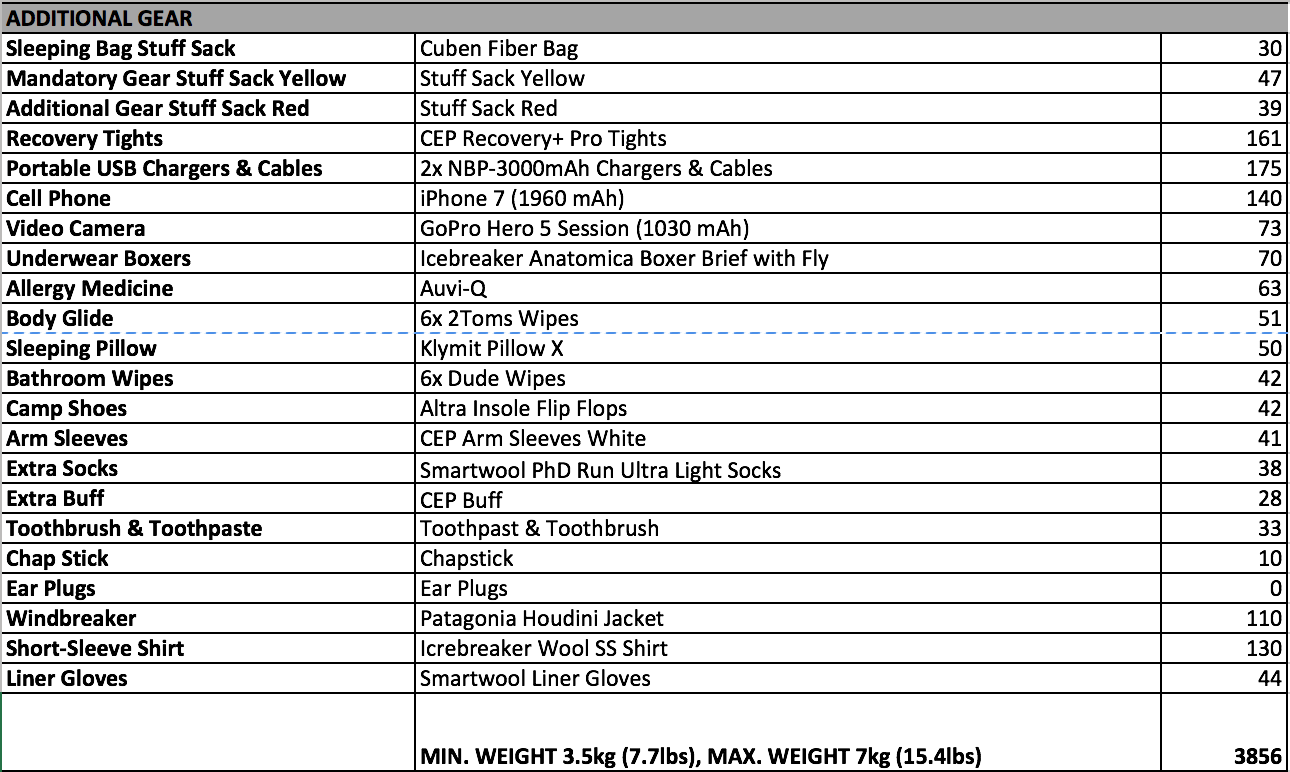
The weather conditions and duration of the event require participants to not only carry mandatory gear, but also other gear that while not mandatory really should be considered required gear. Of course, opinions and needs vary widely, which explains why I have spent the better part of the last 9 months in buying gear, exchanging gear, adding and removing gear from the lists and why I am still not done. Is my sleeping bag warm enough? Is it to heavy? What kind of clothes will I need/want in camp? How will I keep essential ear dry inside my back? Will the pack work? Do I choose wool over synthetic? You get the idea, questions upon questions upon questions, and I'm still changing things.
Mandatory gear laid out prior to test packing.
As I enter the final days of race prep, it was time to actually lay out all gear and try to fit it all inside a 20l running pack. While I had some of the gear in my closet already, the special nature of the event required some purchases to allow the best possible outcome during this stage race. While regular tech shirts certainly work great during a single day race, wearing the same shirt for 6 days straight raises some concerns that may be better addressed by clothing that consists mostly of merino wool fibers. In addition, the weight of gear plays a major role when having to carry all of your gear during a 6 day race.
Optional gear list for Everest Trail Race.
The lists and images in this post reflect the logistical planning of the last 9 months. I plan to test out some if not all of this gear during some acclimation training as well as a last training cycle to try to replicate the conditions on race day, both in regards to weather and terrain. Hopefully, meticulous gear planning coupled with altitude acclimation and terrain specific training will put me in a position to complete this event with as little problems as possible. My goal is to have the experience of a lifetime with as few mid-race disasters as possible. I do plan to push my own pace within my limits (after all, I am quite competitive by nature), but my main goal is to stop and smell the roses and to take some pictures and videos to last  lifetime while moving through what will be the most memorable terrain I will ever encounter.
Option gear laid out prior to test packing.
There actually is a minimum weight requirement for gear of 3.5kg or 7.7lbs and a maximum gear weight of 7kg or 15.5lbs. I was able to keep total gear and pack weight to just 3.8kg or 8.5lbs. Hopefully, my gear planning phase is in its final stages and I can focus on a bit more training in the last weeks leading up to race day.
Mandatory and optional gear packed.
UPDATE: After arriving in Kathmandu, Nepal and before the actual gear check through the race organizers, I had made some final adjustments to my gear list. First, I upgraded my sleeping bag the Zpacks 900 Fill Power Down Sleeping Bag 5F Standard Long (700g) after receiving a last minute report from the race organization that temperatures were exceptionally low, potentially dipping as low as -10 Celsius (15 Fahrenheit). Warmth and comfort at night easily outweighted the weight savings of a smaller/lighter bag. Either way, this sleeping bag was still extremely lightweight. I has also made some other small changes related to toilet paper (I took a combination of tissue and wet wipes). I also replaces individual anti chafing wipes with a stick for weight savings. Finally, i swapped the mandatory compass for a much smaller version.

My pack ended up weighing in at 9.2 lbs (4.2 kg) during the mandatory gear check and that included everything listed above. I did ue almost everything I packed, but I could have saved a little bit more weight by only taking one pair of tights (either compression or long underwear), removing the pair of boxers and the extra short sleeve shirt. The pillow was not a necessity and I had also removed the EPIpen prior to gear check. All in all, I could have come in just above the minimum required weight of 3.5 kg, but either way, I am very happy with my overall gear choices. I may not have used my windbreaker, but I was sure glad I had it just in case. 

30 September 2017

/

Typical views from the Virginal Creeper Trail.
This was quite different from any other race weekend that had come before. For one, I had registered a long time ago, but then really had no intention of running this race after signing up for Fat Dog 120 in August and the adventure of a lifetime, the Everest Trail Race in Nepal, in November. I figured two huge events like that would be enough for this year and I could always do the Yeti 100 next year, since it was only a drive away from my home base. However, Wednesday I listened to the East Coast Trail & Ultra Podcast that had Jason Green on to talk about the race and it got me thinking. I hadn't done a race spontaneously ever. I also hadn't done a race solo without crew/pacer or any other support in a very long time. Did I still have it mentally to do 100 miles without anyone prodding me on? How about running two 100s just one month apart?

By the time I got home from work, I sent Jason a message if I was still good to go and he said yes. Crap, was I really going to do this? Run a 100 miler in two days? Probably not a good idea, but when did good stories ever come from well thought out plans, am I right? What followed was the fastest race prep ever. Open giant duffle bag, throw in race kit, spare shoes, a bunch of warm clothes, fuel, headlamp, etc., close duffle bag, done. I booked a room at Red Roof Inn, filled up my car and left Huntsville Thursday at noon. While I am usually a social media "overposter", I played this one close to the chest. I did not want any external pressure, perceived or otherwise. 
The town of Damascus fully embracing the Yeti 100 and its participants.
I arrived in Damascus, VA a short 5 hours later, just in time to throw my one drop bag on the trailer outside the historic Rock School that was hosting the race packet pickup and pre-race briefing. Inside, there were about 250 "Yetis" ready to listen to RD Jason Green's final words of wisdom before continuing catching up with friends and heading to their respective accommodations. 
One of the 40+ trestle bridges on the course.
I returned to the Red Roof Inn, finished laying out my race kit for the morning and sent Benj Lance a final text message about meeting in the morning, since he and his dad had kindly agreed to pick me up at the race finish and take me along to the race start, so I could leave my car for later. I still wasn't sure if I was ready, but that did not matter. Once Jason signaled the start of the race, all worries fell away and I just started chatting and running with Benj for a while.
Benj and I had talked about goals for the day and since I really had no goals other than to finish in one piece and hopefully one day, I figured I'd try to stay with him for as long as possible. I've known Benj ever since I spotted him at a local ultra in a Barça jersey some years ago. I knew tight then and there that I would like this guy:-) We really hadn't had the chance to run together much over the years, so this worked out great. 

The race course starts at the east end of the Virginia Creeper Trail at the White Top depot at 3,500 feet elevation and runs approx. 33 miles west through Damascus (also the 50 mile finish line) and Alvarado (the lowest point on the course at 1,700 feet) all the way to the turnaround point and eventual finish line in Abingdon for a total elevation gain of around 3,000 feet and elevation loss of 6,000 feet. 100 mile runners would run this course as an out & back & out, which made the second middle leg of the race course the toughest as runners made the 17 mile gradual climb back to the White Top depot turnaround point.
Many of the trestle bridges feature unique structures.
Benj and I both decided to start conservatively, even including occasional walk breaks on the initial 17 mile downhill stretch, just to try to save our legs for the later stages. While this is a rails to trails path with mostly hard-packed dirt and gravel surface, the courses elevation profile invites or almost forces participants to run most if not all of the race...until they can no longer do so. The mostly even surface also meant that the same muscle groups and tendons would be doing most of the work during the race. This was not all all the type of training and racing I had been doing all year, quite the opposite.

Most of my races this year have had serious elevation profiles and fairly technical terrain, so I was used to climbing a lot and descending a lot, which meant fast running, but also lots of "walk" breaks on the uphills. Not so at the Yeti 100 Mile Endurance Run. This race invites, asks and even lures runners to run until they can run no more. With a few exceptions, Olivier Leblond being one of them. A member of the USA 24 Hour National Team, Olivier was smiling all day as he crushed the 100 miles in 14 hours and 4 minutes, setting a new course record. Most others would eventually find out just how difficult it is to run 100 miles. I was one of those runners.
Benj and I caught up on each others lives and adventures as the early miles ticked away quickly. We ran a very conservative pace, giving me no reason to worry. While this course was a lot flatter than most of my other recent ultra adventures, it was just as beautiful if not more so in many cases. This rails to trail includes over 40 trestle bridges that runners would cross 3 times each. Most of the bridges had unique design features and were of varying lengths, mostly constructed of wood and some steel. The landscape was absolutely stunning. 
Imagine my disappointment when I did not find any Fireball:-(
We rolled into the first aid station at mile 10, I refilled my bottles and we continued on. Somewhere along this section, Brett Addington, a fellow Huntsville runner, RCM pacer (more successful than me, but that is another story;-) and first time 100 miler, passed us. I never saw him again and he finished this race well under 24 hours, congrats again, Brett! Benj and I continued to keep our easy pace all while meeting new and old friends on the course. 

Before we knew it, we had arrived at the mile 17/50/84 aid station in Damascus for the first time. I located my drop bag, grabbed some more Honey Stingers and some Sword, downed a can of Coke and went on my way. During this next stretch, Benj's stomach started to give him trouble, nausea and pain, possibly related to a bug he dealt with the previous weekend that had landed him in the ER. I reminded him to take extra care to get enough electrolytes and nutrition since his body was already depleted from dealing with the bug earlier in the week.

Unfortunately, we would not hit an aid station soon enough to allow him to address some of his issues. Instead, he needed to slow down to allow his stomach not to get worse. I stayed with him for a few miles before pushing ahead to stay on pace. I notified his dad at the next crew spot, so he would be ready to get him going again. I was sure he would catch up to me later on. I figured it was only a matter of time until my legs would get tired of running without significant walk breaks or downhill running.
Much of the Virgina Creeper trail runs along Laurel Creek.
I continued my pace strategy, actually running a little bit more now on the flats and the slight incline towards Abingdon, reaching the 33 mile turnaround point in just over 6 hours. After a high five from Jason Green, RD extraordinaire, refilling my bottles and catching up with David Thurman and Russ Dixon, two fellow Huntsville area runners and both equally surprised to see me out there, I went on my way to get back to the White Top depot. I was mentally prepared for this section to be the toughest.

However, I wasn't prepared for my stomach to go south on me as I rolled into the 50 mile AS in Damascus. There were long flat stretches of the race course between mile 33-50 that were fully exposed to the sun and while the temps were only in the mid 70s, it was enough for me to get hot and for my stomach to start revolting. None of the foods looked appetizing to me, so I stuck to a cup and ginger ale and a cop of Coke. This and one single cup of ramen noodles along with my Sword drink mix would be the only calories my body would accept for the remainder of the race.
There were constant reminders that this area does have some beautiful mountains.
On a positive note, I stayed with the same pair of wool socks and Altra Timp for the entire 100 miles and did not develop a single blister. However, my pace continued to slow as the day turned into night. I was now running alone and continued to run alone for the next 30 miles. I was actually able to move uphill better than I thought, but the low levels of energy caught up to me and my pace continued to slow. Walk breaks became longer than I wanted them to be, but it became harder and harder to start running agin. 

It wouldn't be until mile 80 that I joined up with another runner after I took a pretty hard fall and he helped me "dust" myself off. Nick Schuster and I would stay together until the very end and while he says that I helped him get there, I can only return the compliment. Nights are even "darker" 80 miles into a 100 mile run and while it it nice to spend some time alone during an ultra to reflect, I am most definitely a social animal that enjoys the company of others, especially during the dark long hours of an ultra. Congrats again to Nick for completing his first 100 and for doing so in under 24 hours. Good luck at Pinhoti 100 next month. You are one cray cray dude, but I have confidence that you will do great there as well.

While we mostly followed a run walk strategy for the final 20 miles, swapping race stories and adventures made the time go by much quicker. However, we were both glad when we finally spotted the finish line with Jason Green patiently waiting for each runner to arrive, so he could give them the biggest bear hug ever followed by awarding the coolest finisher buckles in the ultra world. I was ecstatic to have completed the Yeti 100. The picture below shows the spoils of "war":-)
Swag and awards done right.
I came to this race to find out what Jason had created. I came here to get one of the most badass buckles awarded to 100 mile ultra finishers. I came here to see if I could still run an ultra solo without support crew and pacers and without the usual 6 month build up. I came here off the high of completing two very tough ultras in the previous 6 weeks, wanting to see if had what it takes mentally to finish another 100. I was able to accomplish all of these goals.

However, while I may not have had crew/pacers along for the journey, fellow runners Benj and Nick as well as their crew Bob, Amanda, David and Russ were a definite help on my journey. Their support along with RD Jason Green and his entire crew of volunteers, cheerleaders, unicorns and yetis not only allowed me to succeed in getting that sub 24 hour buckle, but they made it a amazing journey and experience. Thanks everyone, hope to see you again on the trails, soon!

16 September 2017

/

Magical moment midrace.
"The extreme highs and extreme lows of the Barkley Fall Classic 50K" would be an appropriate title for my race experience this weekend. Let's start with the good news, I finished. However, there were a lot of things that transpired between starting the race on a mild Saturday morning at 7AM and finishing the race around 6:30PM on the evening of that same day. Yes, you read that right, it took me more than 11:30 hours to cover the 50K distance, but that is actually not all that unusual when you are talking about the Barkley Fall Classic 50K, also lovingly referred to as the "Baby Barkley". But first things first.

Rob Youngren and I carpooled to Wartburg, TN, leaving Huntsville around noon. Dana Overton had reserved a camping spot at Frozen Head State Park and was kind enough to let us share her spot, giving me the opportunity to test out some new camping gear ahead of a couple of major adventures, but that's another story. While I was "glamping" last year by staying at the Holiday Inn, this year camping at FHSP sounded like a fun idea. Rob and I arrived at packet pickup with plenty of time, chatted with a few folks and then left to head to the campground to set up camp. Dana joined us shortly after and we all went to the most happening Asian restaurant in town for our pre-race meal where we were coincidentally joined by DeWayne Satterfield. If you've seen the Barkley Marathons documentary, then those names should ring a bell, but enough with the name dropping...
The weather gods were kind enough to shroud Testicle Spectacle in clouds, so our ability to comprehend the immensity of the challenge ahead was limited.
We returned to camp right around dark and everyone pretty much turned in for the night right away. I dozed off pretty quickly, but after waking up around 1AM to rid myself of some pre-hydration fluids, I was unable to get back to sleep, so I laid there for another 4 hours until my alarm finally went off. After a quick coffee, breaking down camp and short bathroom stop, we were off to the race start, arriving around, giving me plenty of time to say hello to the large group of Huntsville runners and other running friends who had made the trek to Frozen Head State Park to get just a glimpse of what it may be like to be "out there".

I toed the starting line alongside about 350+ runners and only a third of them would return in time for an official 50K finish. Regardless of the finish, be it a 50K, marathon or DNF, I venture a guess that everyone had a blast. Where there low points? Of course. Where there high points? Hell yes! Was it the both the hardest and longest 50K anyone had ever done? Quite possibly, but I'm not looking to start that discussion. I definitely experienced all of the above.
Shuttle for those that couldn't or didn't want to face Rat Jaw. 
I had run this race for the first time last year and before my skin had even healed from the 2016 BFC 50K, I had signed up for this year's edition. I had done pretty well considering my state of training at the time and I actually had a great time as well, so why not. I really had no expectations for this race as I was coming off my goal race of the year, Fat Dog 120, four weeks earlier. However, my vert training leading up to Fat Dog had given me just a bit of confidence, so much so that my secret goal was a top ten finish, but since I had no idea who else was running, it really wasn't that important of a goal. The plan was to start extremely conservative, just like last year and to slowly pick up effort once the race was well underway and I knew how I was feeling on the day.

Well, leave it to Laz to create plenty of buzz, excitement and nervousness by making some subtle changes to last years course. The sections were essentially the same as last year, but the order was changed around and there may have been a section run in reverse.

As the race got started, I had lined up somewhere in the middle of the pack, maybe just at the tail end of the front third of runners. I was looking around for familiar faces and kinda fell in line with some of them as we made our way up the gentle 4 mile slope that was the first climb of the day. The usual train of runners had formed, ensuring that I wasn't going to be running too fast too early in the race and as the trail widened, I started to pick up the pace just a little. A quick stop at the first aid station and I was on my way again. This next section was all runnable as we approached the first mayor highlights of the day, Testicle Spectacle followed by Meth Hill. Everything looked way more overgrown than last year.

I put on some work gloves and started my descent down Spectacle. About halfway down, David Riddle came past me in the opposite direction, leading the race just as I had expected. However, another runner followed by a large lead pack were hot on his heels. I was surprised to see them this close, but David had told me that he had initially missed the turn down Spectacle, losing some valuable time before realizing the directional error. Runners kept passing me in the opposite direction and I quickly lost count. I really was surprised just how many runners were ahead of me at this point. It seemed the course change had either invited runners to "bank some time" early or I was moving much slower than I thought. Oh well, I thought, there's a lot of race left to do and a lot of things can change. Boy, was I right!

I continued my descent, got my bib punched at the next aid station and returned back the way I came. Up and over the hill and down Meth Hill I went, butt-sliding through briars until we finally entered some runnable terrain again before arriving at the prison at the bottom of Rat Jaw. A "minor" clarification on the race rules (i.e. stay under the powerlines at all times) combined with 8ft tall briars all along the Rat Jaw power line cut that had not been cut this year led to some serious doubt in my mind. I'm not gonna lie, there was some serious cursing going on before, during and after this section. I may owe a few peeps with sensitive ears an apology for my choice of language at times.
The only time you will ever see me ahead of David Riddle.
I refilled my bottles at the prison, only to realize that I had not only lost all of my salt, I had also lost my flask with nutrition, leaving me with a small ziplock bag with chews and my two water bottles, not what I would call a sound nutrition plan for what lay ahead. Here, I caught up to DeWayne and we started the ascent up Rat Jaw together. Initially, the briars were not too terrible. Don't get me wrong, there was no path and they were bad, but it would only get worse as we continued to climb. Just as we cross at the "halfway point", a little spot were the powerline cut levels out for just a moment, one of my worst fears came true. I got stung my a yellow jacket. I am somewhat allergic, but thankfully, I had not stepped into a nest, so two Benadryl seemed to do the trick. I'm sure the kick of natural adrenaline I experienced in that moment helped. The briar cuts also started to mask the pain of the sting.
The home stretch and most definitely my fastest split:-)
As we continued to climb, I started to lift my head to look ahead. I was trying to spot the cliff that runners had to get around before they could continue their track to the fire tower. I literally could not believe my eyes. There was David Riddle just about 100 yards above us, and 30 yards behind him was a large train of about 30 or so runners, seemingly standing still. Within a few minutes, we caught up to them. We weren't sure why they weren't moving and then it hit me, they were moving, the briars were just slowing them down that much.

As more minutes passed I became increasingly impatient. Those who know me would not be surprised at that statement:-) I turned to DeWayne and suggested we cut our own way past this large group. Just I said it, Rob had caught up to us and literally threw himself backwards into the briars, DeWayne and I pushing ahead right behind him. Rob continued to push throw and DeWayne and I and a couple of others followed. Within a couple of minutes we had movd past the train of runners and were making slow but significant progress, extending our lead over the other group. Rob continued to do the majority of the work, sacrificing his body as we pushed behind, trampling down the briars. As we pushed past the cliff, David had joined in with us to get to the top. David was running in second place at this time with the race leader about 15 minutes ahead of us.

I finally stepped up to take the lead after Rob had done the majority of the work. The briars were relentless and with every cut, my cursing got louder. We continued on and finally crested Rat Jaw to the cheers of a large crowd of onlookers and supporters. I was now in third place overall. I had never before been so glad to have been done with a section of a race. We continued uphill and up to the top of the fire tower to collect another punch before heading down the jeep road to the next aid station. This would be one of the easier course sections. There was some jockeying for position on the downhill to the aid station, but I was excited to still be running in the top 5 as I left the next aid station. My secret goal of a top ten finish seemed very realistic at this point. I knew what lay ahead and figured nutrition would be my only challenge, since I had lost all of mine. The next bib punch would be at the Garden Spot, so I settled into a steady pace. Ah, there was the gate that gave me pause last year when I had to resort to the map to confirm that I indeed needed to climb across it to continue on. This year, we came from he opposite direction, but no confusion here.
Atop Testicle Spectacle just before descending down Meth Lab Hill.


Then my troubles began. Eventual third place finisher Ihara Tomokazu was running just ahead of me as the trail appeared to split in a "Y". I know, I know, it's not a intersection, just a short spur going off to the left while the course continued up on the left towards the Garden Spot, but that's not how it looked to me in that situation. I grabbed the map, even yelling at Ihara to stop and turn around. He either ignored me or did not hear me. Either way, I sure am glad he didn't.

I checked the map and noticed a Y-intersection noting the left spur as a red trail, so I needed to go right, I figured. I made two mistakes. First, I got the distances wrong or else I should have noticed that I passed the red (off course) trail much earlier. Second, I did not pay attention to the topographical detail on the map. I knew I needed to climb to the Garden Spot, but I figured the trail would just dip and then climb again. It did, about three quarters of a mile later and after two T-intersections. Why did I not turn around immediately. Well, I figured no arrow at the Y-intersection, so maybe no arrows here either? I don't know. When I finally decided to turn around, DeWayne showed up, oh good, I was on the right trail after all. Nope, he was lost, too. How is that even possible? Anyway, I finally tracked back. I figured I lost about an hour total. Got confused one more time at the next directional arrow and then finally made it to the Garden Spot for my punch. I was the 75th runner to receive my punch, what??? 70 runners had passed my while I was off course. I was deflated.
Me during a creek crossing just before I busted my @$$.
So much for a top ten finish. This one gnawed on me for a long while. I had tried to make up time and that combined with the lack of salt and fuel put me at the lowest point for the day. Luckily I caught up to Dana and Jeff Deaton, so I ran/shuffled along for a while, dropped back, picked up pace again and so on. As I started to climb the backside of Bird Mountain, I decided that I was done once I got to Laz. I had gotten my finish last year, I was tired, why would I want to continue? I spent the better part of the climb and even the descent in an inner monologue of why I was right. There was nothing inside me disagreeing with me. As I was going on, I realized that this was typical DNF talk, justifying quitting to yourself. I was done, but I decided to not call it quits until after I drank my Pepsi and sparkling water that I had stashed in a drop bag. I never ever use drop bags for a 50K, but I had decided to bring trekking poles to train for my Everest race, so I figured I'd stash some refreshments as well. When I finally got there, the drinks were still cold inside my little plastic drop bag.

All day, most things seemed to have gone wrong for me, but now my drinks were somehow still icecold after laying outside for nearly 10 hours. I drank the water, the soda and two containers of coconut water, then I went to tell Laz I was done. I had chatted with Luke Hough and a few volunteers convincing them that I was making the right direction. Luke, figuring that I knew what I wanted, let it go. The other volunteers, however, would not. And when Laz chimed in as well, reminding me of the dreaded DNF regret, I had already decided to go on. I had enough time, my body wasn't as battered as I had expected and another finish would be much sweeter than conceding defeat.

I grabbed my trekking poles and took off. I made it across Chimney Top in less than three hours and clocked my fastest split from the final timing mat to the finish. In the end, I crossed the finish line in just over 11:30 hours, elated to get another "Croix de Barque", this time with a nice shiny star for a second finish. Thanks again to an amazing group of volunteers and for Laz and company for thinking up this and other crazy events for us to find and push beyond our limits. Congrats to everyone that finished or attempted to finish. Will I be back next year? Who knows...
Crossing the finish line exhausted and ecstatic.

US STATES WITH 100 MILE RACES COMPLETED (33)

COUNTRIES WITH ULTRAMARATHONS COMPLETED (15)

Visited Countries Map by Fla-shop.com

RACE CALENDAR

  • Cowboy 200M (Norfolk, NE) - September 25, 2026 REGISTERED
  • Gila 100M (Silver City, NM) - October 17, 2026 REGISTERED
  • Loup Garou 100M (Ville Platte, LA) - December 5, 2026 REGISTERED
  • Southern States 200M (Delta, AL) - March 17-21, 2027 REGISTERED
  • Cocodona 250M (Black Canyon City, AZ) - May 2, 2027 REGISTERED
  • Huron 100M (Grass Lake, MI) - June 12, 2027 REGISTERED
  • Kettle Moraine 100M (Lagrange, WI) - June 2027 DEFERRAL
  • San Juan Solstice 50M (Lake City, CO) - June 20, 2027 LOTTERY
  • Lavaredo Ultra Trail 120K (Cortina d'Ampezzo, Italy) - June 25, 2027 LOTTERY
  • Western States 100M (Olympic Valley, CA) - June 26, 2027 LOTTERY
  • Hardrock 100M (Silverton, CO) - July 9, 2027 LOTTERY
  • Booneville Backroads Ultra 100M (Booneville, IA) - August 2027 DEFERRAL
  • Swiss Peaks Legend 400KM (Brigerbad, Switzerland) - August 29, 2027 LOTTERY

SPONSOR

SPONSOR

YOUTUBE CHANNEL

TRANSLATE

PAGEVIEWS

| Free Blogger Templates