Showing posts with label Idaho. Show all posts

10 July 2021

/


The race had been on my radar for a couple of years. When a combination of work and the pandemic made it less and less likely to run the Ultra-Trail Val d'Aran in Spain, I changed gears and signed up for the Beaverhead 100K in Salon, Idaho. Five weeks out from the first race of the Triple Crown of 200s, the Bigfoot 200, it made more sense anyway not to tax my body to the max, but to challenge myself with a more reasonable distance event as a training race.
I realized very quickly that race logistics would be the biggest challenge. I was unable to locate a rental car anywhere in Idaho or even surrounding states/airports. I eventually decided to drive my camper van across country to the race and to continue to the west coast afterwards to leave my sprinter at a friend's house for another summer adventure later on. I found an awesome campground near the center of town in Salmon in short walking distance from the race shuttle pickup location. With a 2:15AM start line shuttle departure, I really wanted to be as close as possible to the pickup. As it turned out, I didn't sleep but an hour, so it wasn't quite the payoff I had hoped for, but it was convenient nonetheless. It would also mean a short walk back to my campground after the finish line shuttle would drop runners off again.
I arrived in Salmon the day before the race in time for the afternoon packet pickup, pre-race briefing and drop bag drop-off. I drive in from the south, but very quickly noticed a severe haze as I got closer to the Beaverhead mountain range. The mystery was solved as soon as I asked about it in town. A large wildfire 50 miles north of Salmon was the cause for the smoke. It would be a considerable factor on race day as well as fire fighters continued to try to get the blaze under control. 
While there are various airports within 2-3 hours driving distance, there are really only two ways to get to Salmon, from the north or from the south. The town feels pretty isolated and hours from any larger population areas. The mountains were also much bigger than I had expected. To be honest, until I registered for the race, I had no idea Idaho even had real mountains. They do and they were majestic.
There weren't any familiar faces at the pre-race briefing, so I didn't stick around much longer than necessary and dropped of a small finish line bag as well as a small drop bag with additional nutrition and a couple of emergency items. I opted to head back to my campground, instead, to cook a pre-race pasta dinner and prep my gear for the next day to hopefully get to sleep earlier than usual. Everything but that sleep part worked out as planned.
My 1AM alarm came just after I had finally fallen asleep. I got about an hour of sleep after tossing and turning for about 3 hours. Oh well, perfect training for my upcoming 200 milers as I don't expect to be sleeping much there either. I fixed myself a cup of coffee to try to keep my usual race morning routine as close to normal as possible. To be honest, that was about the only thing from my usual routine for shorter distance races, since a 1AM wakeup is early for any race distance. An hour later, I made the short walk to the shuttle pickup for the 2:15AM departure. I vaguely remember the ride, but I do remember plenty of room in the school busses as each runner had his or her own bench for the 1+ hour drive to the start line. Once we arrived and poured out of the busses in the middle of nowhere at Bannock Pass, runners were quickly aiming up for the portapotties lining the area. Massive spotlights illuminated the start area and music blasted from large speakers to get runners amped for the adventure ahead. Temperatures were a bit cooler than expected, so I finally pulled my Houdini windbreaker from my pack to stay warm. I would actually keep wearing this layer for the first couple of hours of the race.
At 4AM, the race director sent us off on our 100k adventure up and over the Beaverhead mountain range. There was a short "sprint" on a dirt road before runners went single file onto single track, starting the first long climb of the race. I settled somewhere in the middle of the conga line and was surprised how many runenrs were eager to push up this first long climb considering how much distance we had to cover for the day. Oh well, I thought, they must all be used to the altitude, because I was certainly feeling it pretty much right away and wanted to make sure to keep both my heartrate and breathing in check.
I felt great making this first climb and as we continued to ascend, the sun slowly appeared behind the mountains, making for a spectacular albeit smoky sunrise. I was carrying both my GoPro and my iPhone to be able to capture as many memories of this amazing landscape as possible. I started to do just that almost as immediately as the sky started to light up ever so slightly. I continued to move fairly steady but slowly over the first 10-12 miles, paying close attention to my breathing. At around mile 15 I started to really wake up, slightly increasing my pace and feeling good doing so. Mosquitos and flies were extremely aggressive all day, so increasing my pace was also a defense mechanism:-) I cruised all the way until mile 27, the unofficial halfway point of the race at the Lemhi Pass aid station, taking advantage of every downhill and moving pretty well uphill as well. That changed as soon as I replenished my nutrition from my drop bag and walked out of the aid station.
Immediately after leaving Lemhi Pass AS runners start a 4-5 mile ascent. Unfortunately for me, the sun had come out all the way at this point with zero cloud cover to give respite from the heat. Within the first half mile, I was cooking and struggling to make good uphill progress. I had a runner just in front of me and tried to keep him in sight to keep my cadence going. Things did not get better and I started to feel worse. The heat started to get to me rather quickly. I went from feeling amazing to feeling awful and slow. I had to back off, so I did.
I had hoped that I would eventually come out of this low point as it often the case in ultras. Maybe this was just a wall and I would get over it quickly. That was not the case. I was now walking way more than I wanted, including the slightest inclines that I would normally have run, instead. The race became test of pure perseverance. I made sure to "smell the roses". After all, that was still the main reason I loved running challenging mountain races...the amazing places you get to explore as an ultra runner that others are likely never to experience.
Things would not get much better, but I kept moving forward. The heat felt relentless. I quickly looked at the positives. I expected to spend much of my 200 mile races hiking, so this would be great training. Time on feet is as important a miles run, so I embraced every extra hour I spent out there. I took lots of pictures and a ton of videos, especially on one of the highlights of this race, the scree scramble across a massive ridgeline and across the highest point of the race above 10,000 feet. When we started the final 8 mile descent, I was still in great spirits. This would not change for another 5 miles, when I had started the final section down a OHV accessible "road". I decided to start a slow run down to the finish line rather than continue my speed hike. Not 10 seconds later I severely rolled by right ankle, which I had been nursing for months and which continued to give me problems. I had made it through 59 miles that included 2+ miles across a large scree field without rolling it once and here and now, on a tame downhill jeep road, it had rolled and popped as worse as ever. I was able to continue to walk without pain using my trekking poles for some support, but my pace slowed even more. Thankfully, I had enough of a time cushion to still make it across the finish line with plenty of time to spare, but it wasn't at all the plan I had had.

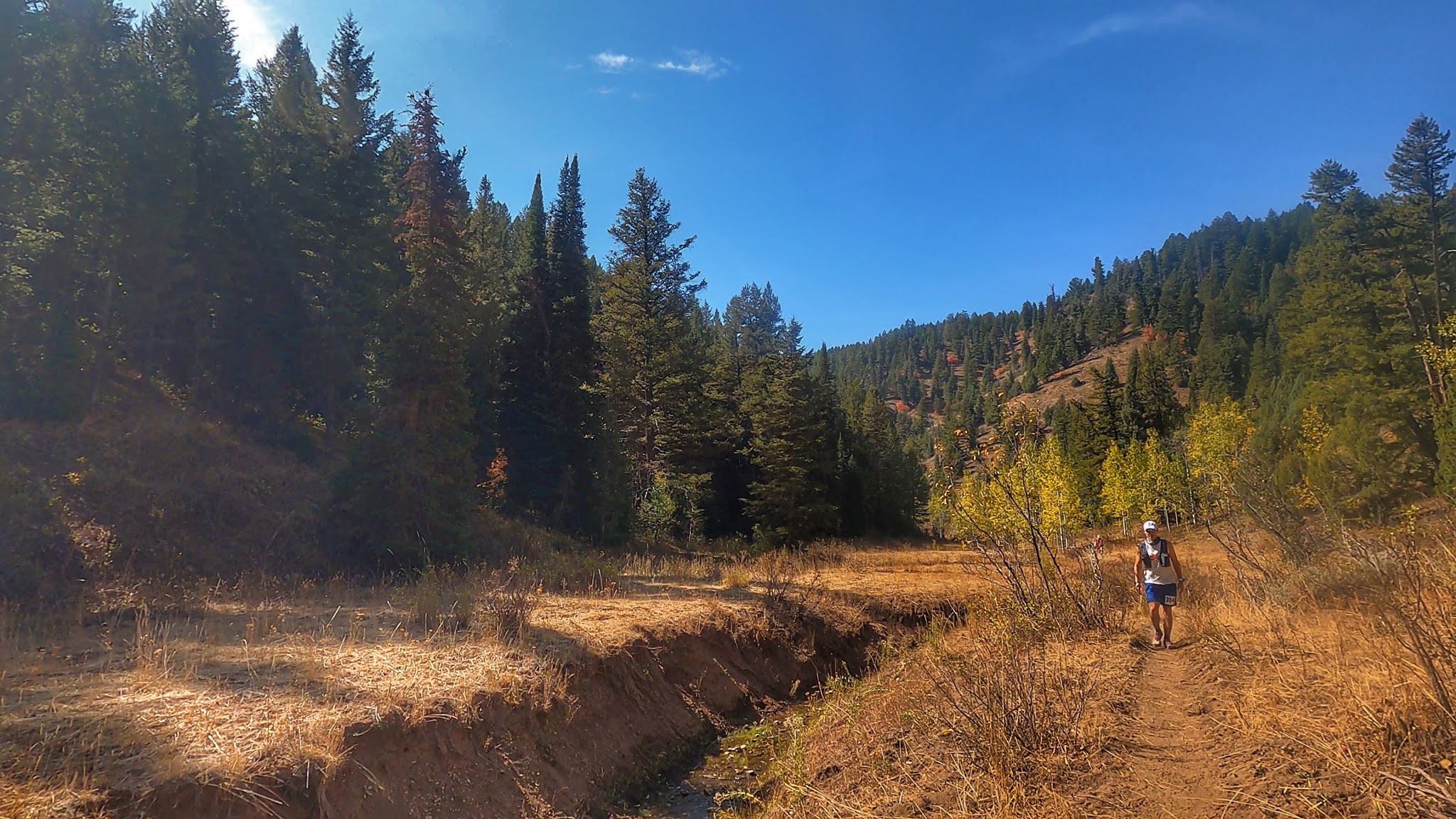
While my race didn't play out at all as planned, one thing that exceeded my expectations was the scenery. Hopefully, the beauty of this area comes through in my pictures. I encourage anyone reading this post to put this race on their list of must do events. You won't regret it. Just be prepared for a little bit of ridge line scree running towards the end of the race. Embrace it as you are rewarded with some of the most spectacular views rivaled only by the San Juans in Colorado.


26 September 2020

/

Witnessing the sunrise from the top of a mountain range is usually a magical experience.
 To say this has been a year of great uncertainty is an understatement. Ultrarunning, just like any other sport, has been greatly impacted by the COVID pandemic currently spanning the globe. As a result, a year that was meant to be full of new trail and mountain adventures in the Alps and the Rockies in Europe and across the US has turned into one virtual race after another around my neighborhood in Huntsville, Alabama. To be fair, it wasn't all bad. While I used to think of virtual races as an opportunity for lazy peeps to make money prior to the pandemic, I actually learned to appreciate virtual races for what they are during the pandemic. They provided the motivation I needed to keep training "towards" something...anything. However, after signing up for and participating in a number of these events to keep myself motivated AND to keep race directors in business, the early shine had worn off again for me.
Thankfully, a few races started to happen again (with strictly implemented COVID precautions) and runners were able to either just register or sign up for wait lists. It had been 6 months since I had ran an actual race, so when things started to open up I started to sign up for a couple of races. Some continued to get cancelled, but some actually started to happen. I finally had a 100 miler to train for again, the No Business 100 Miler in Tennessee and Kentucky in October, just a few hours drive north of me.
I had been ramping up my mileage and training again and registered for and run a couple of shorter events for a couple of months when my phone rang. "Hey man, what are you doing September 25-26 weekend?" "Let me check my calendar" was my response, "Well, I'm running the Barkley Fall Classic 50K the weekend prior, why are you asking?" "Come to Utah and run the Bear 100 with me!" Now, most people would respectfully decline and rightfully so, but this was a strange year and unlike last year when I had already run five 100 milers at this point, I only had one solo 100 miler to my name for the year. Also, I don't recall ever turning down an invitation for adventure, so there's that. So after a brief moment I responded "Hell yes, let's to this!"
When you happen to bump into a friend in the middle of a 100 miler...who also happens to be the freshly minted Colorado Trail FKT holder.
The Bear 100 had been on my bucket list for a while, so I was excited to toe the line. I was concerned about having run the Barkley Fall Classic 50K just 5 days prior, but with no particular time goals in mind, I would be happy just to take in the beautiful course I'd heard so much about and to earn that Bear 100 finisher buckle. And I was just as excited to start the pre race pre and planning, drop bags, gear, etc. It had been a while.
Utah and Idaho in September are an explosion of Fall colors.
When I arrived in Salt Lake City, I met up with my buddy Vic, who'd just arrived from CA and we made our way to Logan, UT. The Bear 100 is a point to point race from Logan, Utah to Fish Haven, Idaho with approx. 22,000 feet of vertical gain. While reviewing the race elevation profile during my race prep, I counted 12 significant climbs. I initially considered trekking poles, but I ultimately stuck to my self-imposed "rule" to limit use of trekking poles to 100 mile races with more than 25,000 feet of vertical gain. 
Sweeping views of the mountains, but smoke from the raging wildfires was visible in the distance.
Race packet pickup took place at a local outdoor sports shop in downtown, Utah. We collected our bibs and spent the remainder of the day either prepping gear in our hotel rooms or taking care of some work. The race would start at predawn the next morning, so the plan was to rest, eat an early dinner and get as much sleep as possible to be ready for the day(s) ahead. 
I caught the train from Logan, Utah....
With the race set to start at 6AM and the race start just a short 15 min drive from our hotel, I set my alarm for 4:30AM on race morning. As a COVID precaution, runners would start in groups of 50 staggered one minute between each wave. I was in the third wave and my buddy Vic was in the sixth wave. We had decided early on to try to run together for as long as possible, so once the race got underway I decided to wait on him at the bottom of the first (and biggest) climb of the race. It was still dark, which made me think we'd reach the top of this climb just in time for sunrise. 
....to Fish Haven, Idaho.
The weather forecast for the race weekend looked very promising and it did not disappoint. Low temps around high 30s/40s and highs in the mid 70s with 10% chance of rain. Thankfully, we only experienced about a 2 min drizzle of rain, which is not worth mentioning for a race notoriously known to experience hours upon hours of rain fall leading to extremely treacherous running conditions. In short, we got extremely lucky. 
Logan, Utah as seen from the top of the Wasatch Range.
We slowly made our way to the top of the first climb near Logan Peak. Due to the narrow nature of the single track trail runners were essentially at the mercy of the runner in front of them and to move at their pace. This is nothing new in trail races and it's known as being caught in a "train". Now, this can be both a blessing (making sure you do not start out too fast) and a curse (you are forced to move at a pace other than your own). However, it was very early in the day, so I wasn't worried. 
My buddy Vic crushing is second consecutive Bear 100 finish.
Once we made it to the top, we were rewarded with a nice runnable downhill that was wide enough to allow us to pass other runners. Vic and I stayed together through most of this descent and the next climb. However, it was shortly after the second climb were we lost touch with each other. I had decided to push ahead for a quick bathroom break and it is at this point that we lost touch. I continued to move at a comfortable pace, hoping that we would reconnect at the first aid station with drop bags at mile 19, which we did. I was finishing up refilling my bottles and reloading gels and drink mixes from my drop bag when he coasted into the aid station. We continued on shortly thereafter. The next section was actually the only flatish section I recall from the entire course. Usually, you're moving either up or down. Here, Vic started to pull away from me just walking down the Jeep road as we took in some calories. 5km later we would enjoy another aid station before starting another major climb.
We lost touch again on this climb as our climbing and descending paces were just too different. We would catch up to each other one last time around the mile 30 aid station, where we both agreed to continue on our own and at our own comfortable pace. Just a mile later I spotted the first race casualty. A runner had sought refuge under a small tree just at the side of the trail. It had started to warm up and all the climbing, some of it exposed to the sun must have caused him to overheat. A fellow runner had already stopped and was on the phone to call for assistance, so I continued on. Just 2 minutes later, I bumped into my friend Andrea. After catching up for while,  we took a quick selfie and parted ways.  
I continued on with my usual 100 miler strategy, move at a comfortable pace, don't drag your feet, run by feel and work your way from aid station to aid station, check your time only at major race milestones, no more no less. I did have two time goals at the beginning of the race. First, to finish the race in less than 30 hours to earn the "Grizzly" buckle, second, to finish the race under the 36 hour cutoff and earn the "Black Bear" buckle, if things didn't go well. 
Single track trails and Fall colors...nuff said.
By mile 52, I was still on my "A" goal, but i was about an hour behind my projected pace. I had struggled a bit with the warmer temps on a couple of the climbs and nausea was trying to kill my appetite. Nevertheless, I managed to continue to stay on top of my hydration and nutrition, I just didn't partake in a lot of the aid station foods. I dialed back my salt intake as well as I slowed during the over night hours. Luckily it was shortly after this stretch that I fell in with another runner, which is often the case and extremely helpful during the night sections, when sleep tries to overtake you and your legs try to keep moving slower and slower. Christian and I continued together through the night and I was very thankful for the company as it stayed dark for a full 12 hours. Temperatures started to dip as the night went on and we made sure we wouldn't spend too much time at aid stations and to keep moving. 
By mile 75, my feet had started to develop some hot spots due to the longer than usual sections of walking or hiking uphill. Thankfully, I had stashed a pair of cushy Altra Olympus 4.0 in my drop bag and I decided to change both socks and shoes. This was the best decision I could have made. This shoe wore differently on my feet and hotspots were a non-factor for the remainder of the day. Christian had also given me important intel about the final 10K of the race, suggesting a more cushioned shoe to be a great idea. He was right.
As day broke, the temps continued to sink, especially on top of the ridge lines. However, Christian and I were able to finally overcome the sleepies for good and get a bot more energy. However, as we approach the final 15 miles, it became very clear that we would not be able to break 30 hours at our current pace. Christian commented on it first, saying that he didn't expect his pace to increase and that if I thought I had it in me to break 30 hours, that I should go for it now. I started to do the math. I had loaded the course on my Garmin watch and it predicted a finishing time of 30 hours 45 minutes based on my running to this point. I started to look at the actual race clock. I needed to run 16 min miles for the remainder of the race to break 30 hours. However, there were still two major climbs left, a long one and a short and extremely steep one. Regardless, I knew I'd beat myself up if I didn't at least give it a shot. With Christian's encouragement I took off down the mountain.
Less than a mile later, I arrived at the second to last aid station. A quick bottle refill and a banana and I continued on my way. I was finally on a mission. Of course, the course started to climb and continued to do so for 3-4 miles. I still managed to run most of it taking short walk break in the process. Even though I was pushing, I had to pull on my rain jacket to stay warm. Temps were chilly. This section felt endless, but eventually I arrived at the mile 92 aid station expecting to see our crew. A misunderstanding had them waiting at the finish line, but just as well, I opted not to even dig into my drop bag and just keep going after another bottle refill. 
Even trails that appeared fairly level either went up or down, there are no flat sections.
I had one massive climb left and it was a doozy. Just short of a mile this climb had me on my tippy toes all the way, but when it finally topped out, I was able to really run. I'm not sure how many runners I passed over the final 15 miles, but it had to have been nearly 30.
I finally crossed the finish line in 29 hours and 16 minutes, having made up nearly an hour and a half over the final 15 miles. Thanks Vic, Chris and Hugh for being such a fun crew and thanks Christian for the company for the tough night hours. Finally, thanks to the RD and the entire crew of volunteers for making this thing happen in these difficult times and when just about everyone else had to cancel their events.
Lots and lots of beautiful single track trail.
Check out the race video I created below:


US STATES WITH 100 MILE RACES COMPLETED (33)

COUNTRIES WITH ULTRAMARATHONS COMPLETED (15)

Visited Countries Map by Fla-shop.com

RACE CALENDAR

  • Cowboy 200M (Norfolk, NE) - September 25, 2026 REGISTERED
  • Gila 100M (Silver City, NM) - October 17, 2026 REGISTERED
  • Loup Garou 100M (Ville Platte, LA) - December 5, 2026 REGISTERED
  • Southern States 200M (Delta, AL) - March 17-21, 2027 REGISTERED
  • Cocodona 250M (Black Canyon City, AZ) - May 2, 2027 REGISTERED
  • Huron 100M (Grass Lake, MI) - June 12, 2027 REGISTERED
  • Kettle Moraine 100M (Lagrange, WI) - June 2027 DEFERRAL
  • San Juan Solstice 50M (Lake City, CO) - June 20, 2027 LOTTERY
  • Lavaredo Ultra Trail 120K (Cortina d'Ampezzo, Italy) - June 25, 2027 LOTTERY
  • Western States 100M (Olympic Valley, CA) - June 26, 2027 LOTTERY
  • Hardrock 100M (Silverton, CO) - July 9, 2027 LOTTERY
  • Booneville Backroads Ultra 100M (Booneville, IA) - August 2027 DEFERRAL
  • Swiss Peaks Legend 400KM (Brigerbad, Switzerland) - August 29, 2027 LOTTERY

SPONSOR

SPONSOR

YOUTUBE CHANNEL

TRANSLATE

PAGEVIEWS

| Free Blogger Templates